 Rooslawn's Unmapped Worlds
I was 9 and Deus Ex let me kill everyone in Battery Park
Every time I visit New York, I make an effort to stop by Battery Park at night. The place has changed over the decade I’ve been making the trek - fewer rats now, and I didn’t see as many homeless folks when I stopped by last year. The rats added to the ambiance, so that was a tad disappointing. And a lot less murder than my 9-year-old self remembers.
I ran across Deus Ex as one of the few games installed on my uncle’s PC. I didn’t read any of the dialog, and the plot went over my head. I think I made it through the first few levels by brute force alone, methodically exterminating everyone in my path.
My most vivid memory is running around Battery Park at night. I didn’t know it was a real place. I’d never played a game that made a space feel so real - the subway stations, the monuments, the rats. I think there were terrorists too, but I don’t remember those. What I remember is how responsive the world felt. I could pick up anything that wasn’t nailed down. Crawl through unmarked ventilation shafts. Stack boxes to get into places I wasn’t supposed to be.
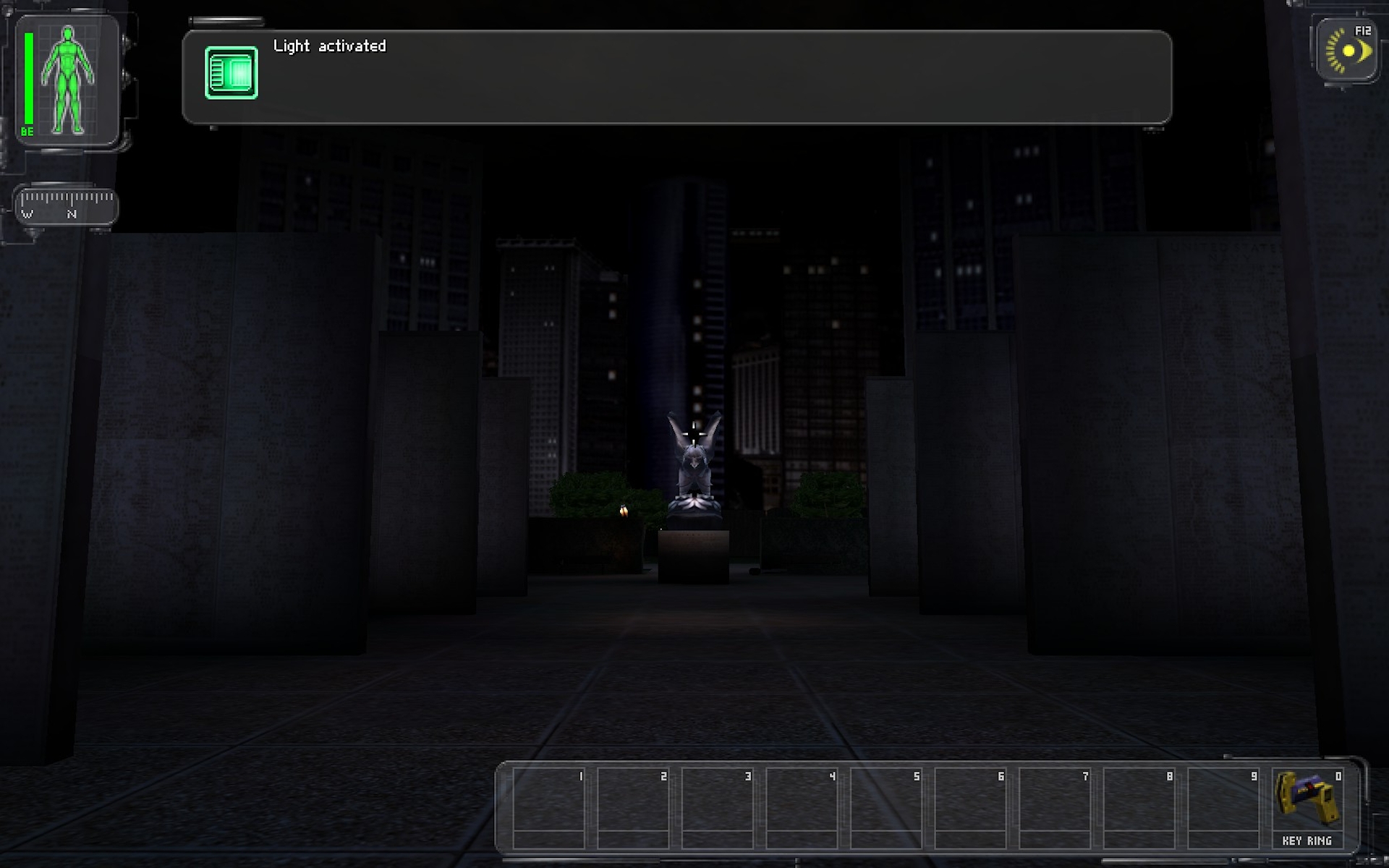 This is The East Coast Memorial in New York’s Battery Park. It’s the game’s second level. Probably as far as I’ve gotten when I was a kid.
And I could kill everyone in my path, and the game would let me, and it wouldn’t really judge me for it. Was 9-year-old me a psychopath? Not really - killing in games is an engaging mechanic, and there’s a healthy disconnect between what’s on screen and an impressionable young mind. But it was incredible that the game let me, and somehow still let me finish each level.
I’ve been chasing that feeling ever since. After a good decade of stumbling around, the first game that hit similar beats was Dishonored. Dishonored is just like Deus Ex - it has stealth, it has a conspiracy, and lots of gadgets (aight, aight - it got magic too).
Dishonored has lots of ways to play. You can be a stealthy, quiet, merciful hero. You kill no one, come up with creative punishments for the villains (arguably much more horrifying than murder), blink around the rooftops and crawl through the tiniest openings. Or you can be a complete menace and rain destruction on everyone in your path: grenades, whirlwinds, swarms of rats under your control. One time, a guard pulls a trigger, I slow time, possess him, walk in front of the bullet - and let go. Overkill? Yeah. But sure as hell satisfying.
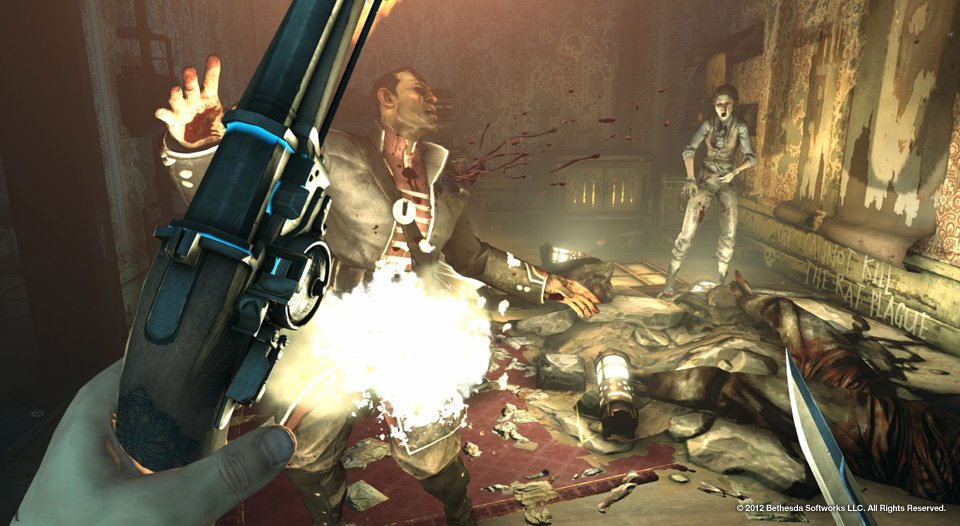 Dishonored is much more fun to play with full mayhem - you get to use Corvo’s enormous arsenal of murder gadgets and devastating spells. Pacifist playthrough is… fine, I guess.
Chaotic aggressive playthroughs are where Dishonored truly shines. 90% of the game’s toolkit is built around lethal improvisation.
And then the judgment kicks in. The world becomes bleaker. You lose friends, the plague consumes the city. Your actions are a miasma on this world - and you feel terrible. The game is reacting to how you played, sure, but it’s also very clearly telling you there’s a “right” way to play. Unless you’re a terrible human being, that is.
I played through Dishonored twice. Peaceful first, chaotic second. The second run was much more fun - and I would’ve hated how the story turned out if I hadn’t already gotten the “good” ending on the first go. The game punishes you for the fun playthrough.
Deus Ex didn’t judge me for being a murder hobo (and murdering hobos). Dishonored hands me all these fun tools, and then grades me on their use. Either see the “good” ending, or have more fun playing a thinner game.
You might be wondering why I went straight to Dishonored when Deus Ex: Human Revolution came out the year before. Yes, I’m sure you have an eidetic memory for game release dates and this is your top question.
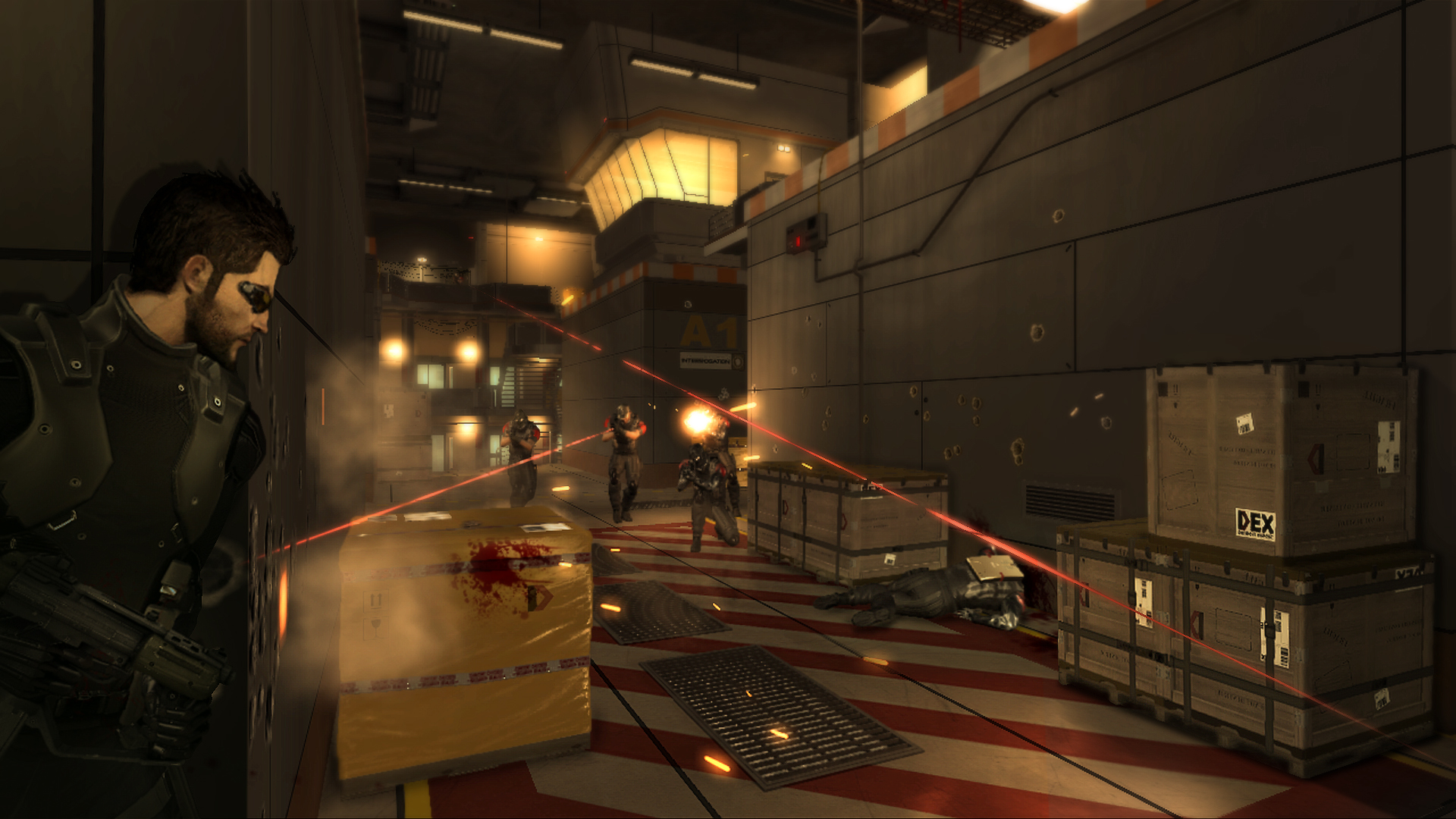 Sometimes Deus Ex: Human Revolution feels like a corridor shooter. With lots of yellow tint, of course.
I played Human Revolution. It just didn’t connect the same way. It felt streamlined in a way the original never did. Every ventilation shaft meticulously placed and marked. Every ledge with a smidge of yellow paint so I know where to jump. The original felt messy, inconsistent - like a real place that happened to react to my presence. Human Revolution and Mankind Divided felt like corridor shooters with a lot of options.
They’re good games, both of them. I enjoyed the gameplay, and Jensen’s voice acting was top notch, even if I didn’t much care for the yellow filter on the whole world. But the sense of wonder isn’t there, and I think I know why.
In Battery Park, I felt like I was trespassing. In Detroit and Prague, I felt like the developers kindly prepared signposts for me.
Which is the other thing I want to say about Battery Park. Battery Park rewired how I look at game spaces. It also rewired how I look at rooms. Hotel hallways. Office buildings. The backs of grocery stores. I catch myself, still, clocking vents and stacked crates and the angles security cameras don’t cover. A useless permanent skill (and no, I’m probably not very perceptive anyway).
 I enjoyed Weird West - it plays with a different perspective, but it’s a true immersive sim at heart. The game lets you do everything you can think of.
It feels less useless in games. I check everything. I stack things. I try to jump onto things the game clearly does not want me jumping onto. I spent the first two hours of Prey opening every drawer in the Talos I lobby because I remembered, somewhere in the back of my brain, that in Deus Ex there was a reason to open every drawer. Prey rewarded me for it. So did Weird West. So do the small handful of games that still believe the player might, unprompted, look.
I don’t think those games are trying to be Deus Ex. They don’t need to. They just have to trust that someone’s going to walk into a room and start looking, and put something there for them to find. That’s it. That’s the whole contract.
Give me an unmarked vent and a drawer that might have nothing in it. I’ll be there for hours.
Comments
Respond directly on Medium (view comments there).