 Rooslawn's Unmapped Worlds
City builders should stop trying to do everything
I spent a little over a week of my gaming time building dams and terraforming the land in Timberborn - granted, that’s about 20-or-so hours these days. And now I have some new thoughts on what I like and don’t like in city builders.
I don’t have a particular attachment to beavers, especially anthropomorphised ones. The way they build dams is cool, I guess. I consider myself somewhat of a city builder veteran - I’m not particularly great at these games, but I’ve played many, many titles, and I’m quick to pick up and master the core themes. Timberborn is many things - a survival city builder, a terraforming puzzle, and a factory automation game. And it’s been out for a while, through a lengthy Early Access period, so I’m late to the party. But the 1.0 release caught my eye, and I figured - sure, beavers.
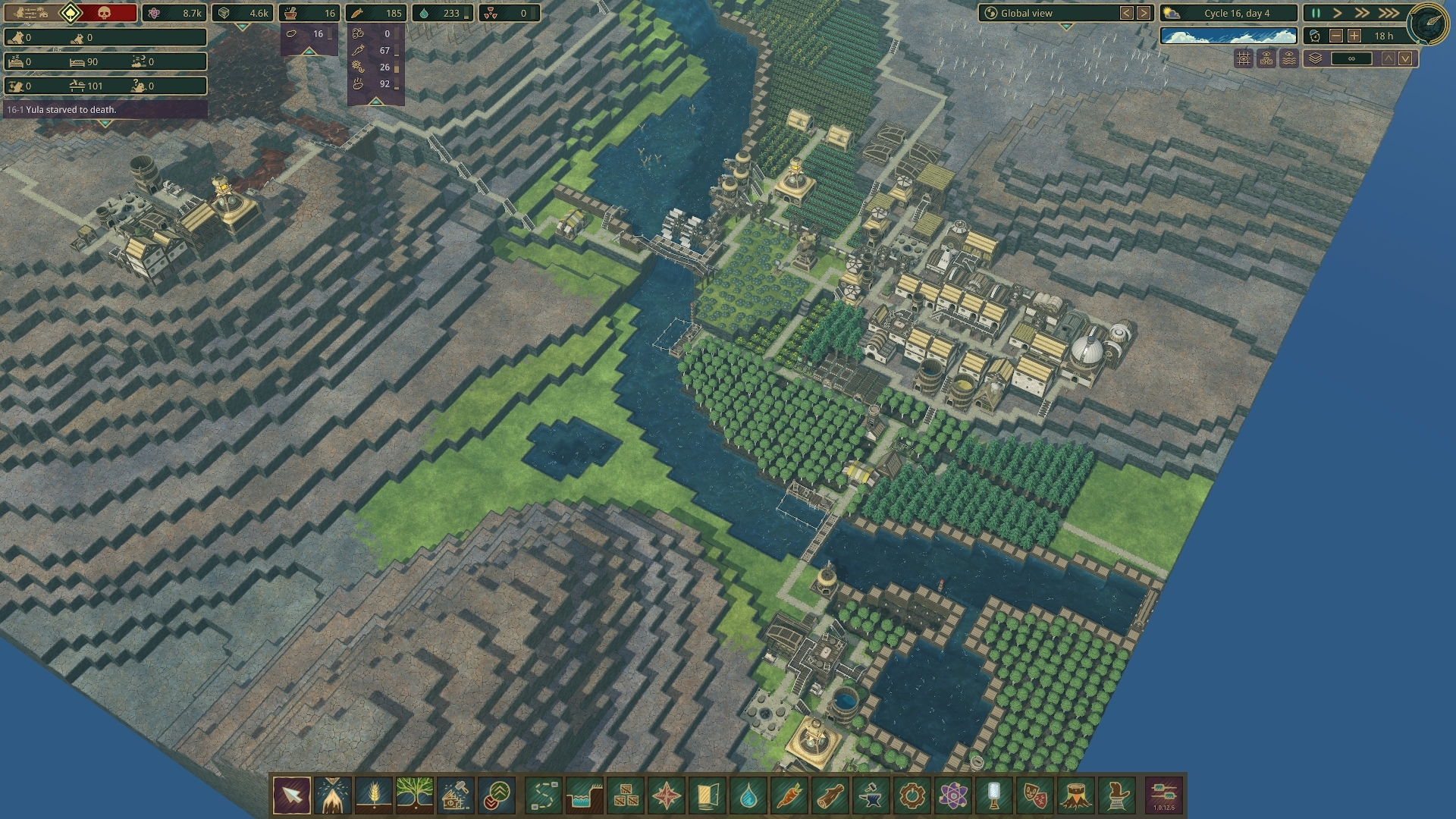 I never thought I’d care about beavers, but I do. A discerning viewer (and a seasoned Timberborn player) might notice that there are no beavers here. They’re all dead, because I didn’t pay attention.
Either the older I get, or the more games I play, I put more emphasis on singular, focused experiences. I like when games do one thing, and do it well. Throughout the typical Timberborn run, I’ll play 3 or 4 different games. I start off with a basic survival city builder, ensuring everyone’s sheltered and fed. Then it becomes a terraforming puzzle. Then a factory automation game. Timberborn has been the opposite of a focused experience - and it’s helped me figure out what actually works at each phase of a city builder.
Timberborn is a good game that I’m about to be unfair to.
Survival without teeth
Timberborn starts you off with the basics - thirst, hunger, shelter. There’s some food planning and water management, but the food doesn’t spoil, and pumped water doesn’t evaporate. Large stockpiles are the answer to every question. Survival elements feel a little wooden, it’s fine enough.
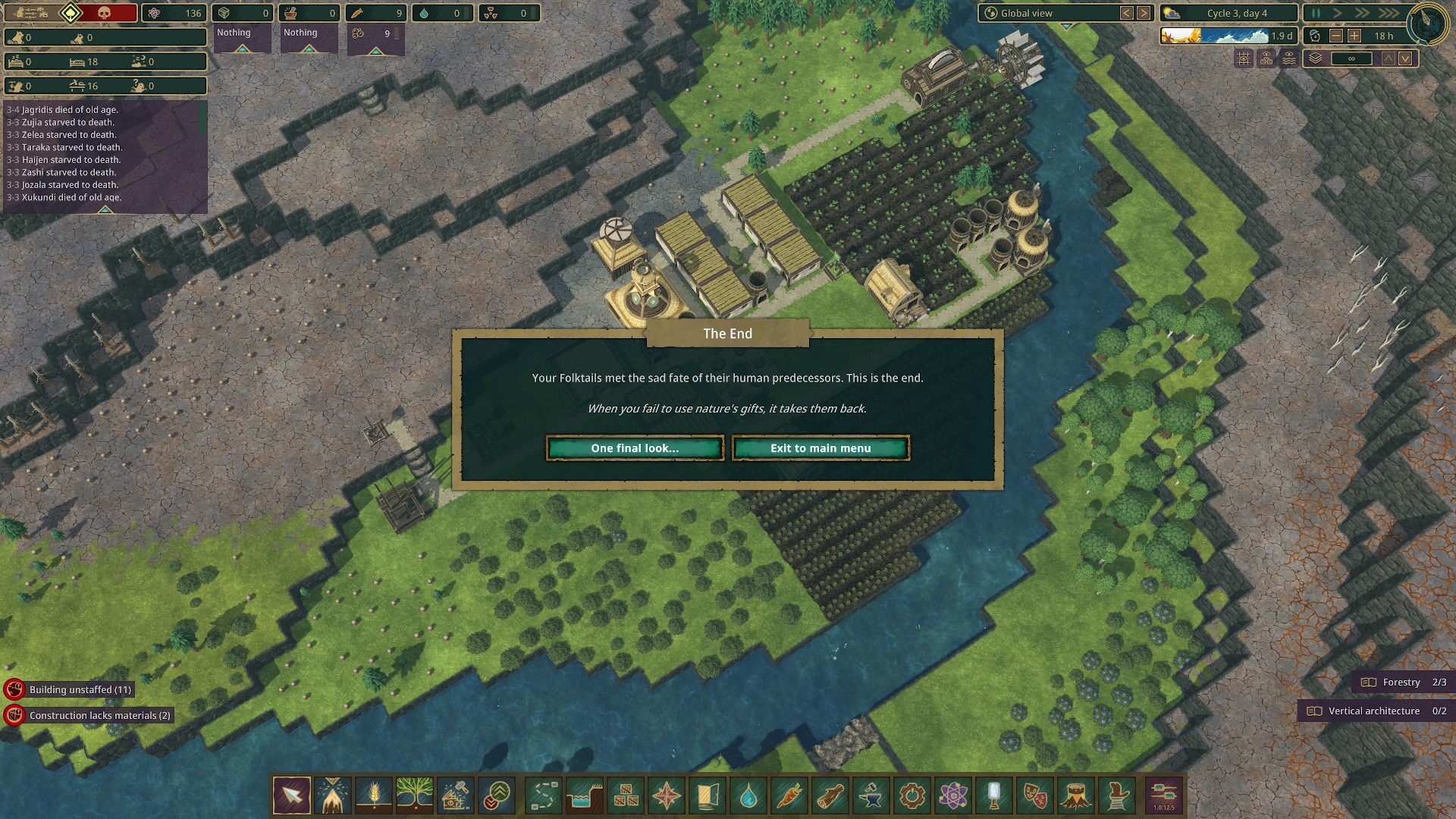 I’ve killed my first two beaver colonies. I actually love when city builders do this - failure is an effective teaching tool, and “everyone died” is a good story.
In contrast, I like how Farthest Frontier, inspired by the excellent Banished, handles survival mechanics. Food spoils, so you can’t overproduce. You can overhunt, overfish, and overlog - so you have to keep a careful balance when extracting resources to avoid starving. There’s a real puzzle in the early game, not just a number to grow.
My first Farthest Frontier run ended because I annihilated the local deer population and ran out of food. My second run ground to a halt after I completely chopped down the only forest on the map. Those failures taught me something about the systems.
In Timberborn, I never failed in a way that made me rethink my approach. 100% of the time I needed to scale production. The factory must grow, as they say - although the beavers here starve to death and the game grinds to a halt. The punishment for not paying attention is steep (which I’m all for), but waiting for population to bounce back is just… boring.
Mid-game is complicated, but not complex
Timberborn’s main shtick is water infrastructure. You divert rivers, create reservoirs, purify water, and manage droughts. It’s a fun optimization challenge, and it’s extremely satisfying once you successfully divert a river in time for a badtide - which would have killed your trees and poisoned your crops. That’s what the mid-game is made up from - lots of one-off, map-specific puzzles with immediate, satisfying payoff.
This is where I have lots of fun, but have to keep pausing to get back to survival. Do I have enough farms? I might need to flood another valley and throw a farming district on a newly formed shore. Running low on wood? Flood another valley, plant some trees, wait for them to grow. I’ve figured out all those puzzles once, and doing so for the first time was fun, but now I’m just going through the motions. And I have to keep pausing the terraforming projects I’m interested in to set up yet another tree farm, with all the infrastructure.
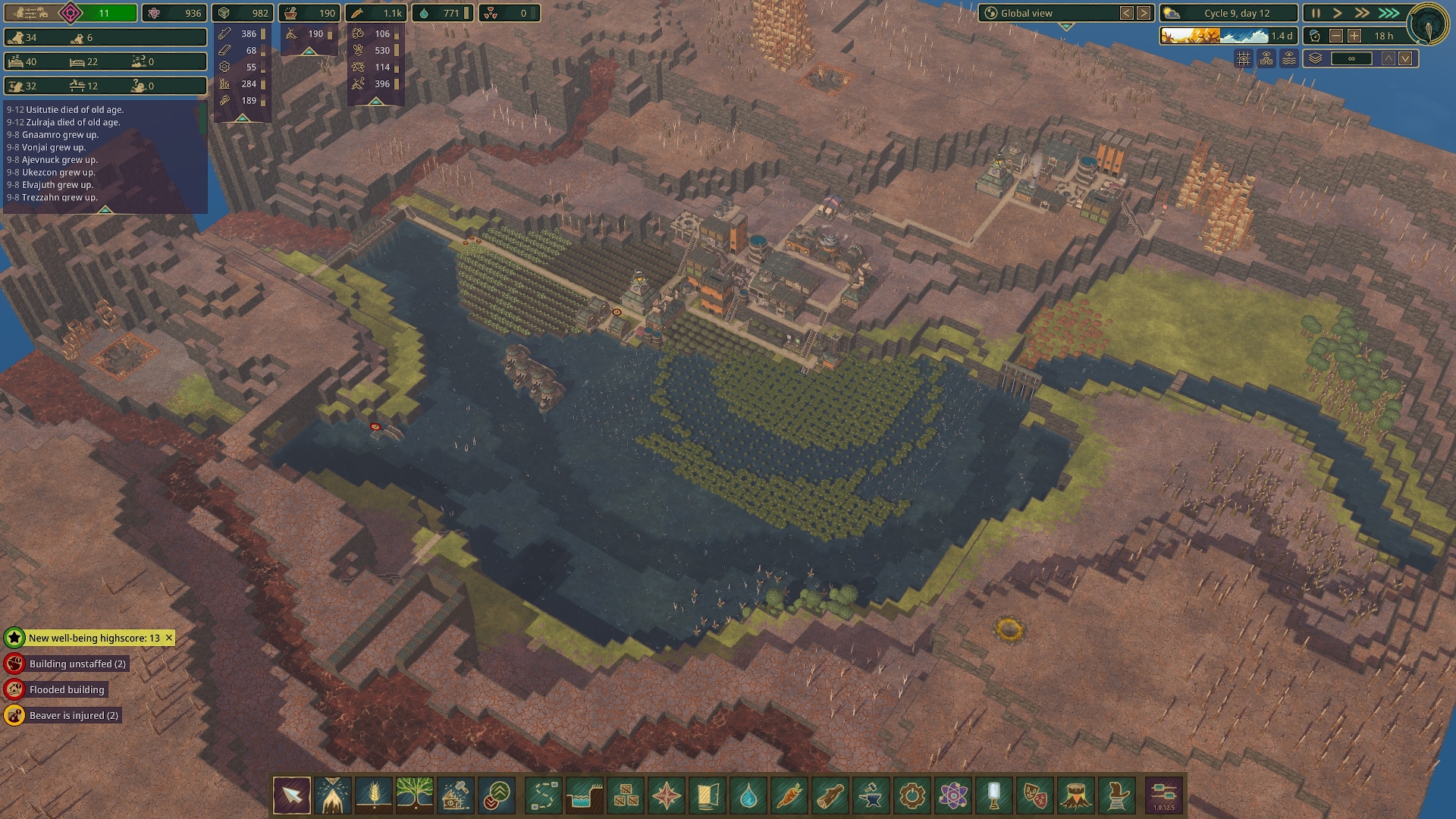 Flooding a valley never gets old - what was a narrow river expands to fill up the whole basin. Seeing the map completely change just because of the few well placed dams downstream feels magical.
And how extensive the infrastructure is. As of 1.0, beavers have 76 various needs to be fulfilled. 76! Different types of food, effects of various decorations, types of recreation… Your beavers get productivity bonuses for each amenity type you provide - a new food type, a campfire, a theater (yeah, these are some cultured beavers). And there are no trade-offs here. The higher the number goes, the more productive your beavers are. Timberborn’s design here is complicated, but not complex. There are lots of systems, but they all say the same thing: more is better.
Dwarf Fortress is complex. Every dwarf has preferences, moods, relationships, vices. Needs conflict with each other and with the situation. I had a guard posted to pull up a drawbridge during a goblin siege throw a tantrum - because he didn’t like that he kept eating the same food. In his defense, he was also dangerously sober and his cat had died the day before. Three compounding frustrations, none of which I caused directly, all of which I could have prevented if I’d been paying attention. That whole fortress got slaughtered by the goblin horde, too.
Timberborn’s 76 needs feel like a long checklist.
Automation and megaproject bloat
Then comes the late game, with its Early Access graduation bloat. Automation is fun, in theory. It’s rewarding to not need to manually control the water flow, or to have a backup reservoir supply water when the water evaporates during a drought. But it feels like a different game bolted on - I’m suddenly playing Factorio, except in Factorio I get in the zone setting up a uranium processing outpost protected by a wall of flamethrowers. In Timberborn I keep getting interrupted to ensure my beavers have enough showers.
And then there are robots. Yup, robo-beavers, who don’t need to eat or sleep but gradually wear out over time. It gives you a singular goal to slowly replace your beavers with the robotic workforce while (hopefully) increasing the quality of life for your shrinking population. But going full automation removes the need for all that complicated need management - which makes you wonder why you spent the mid-game building it.
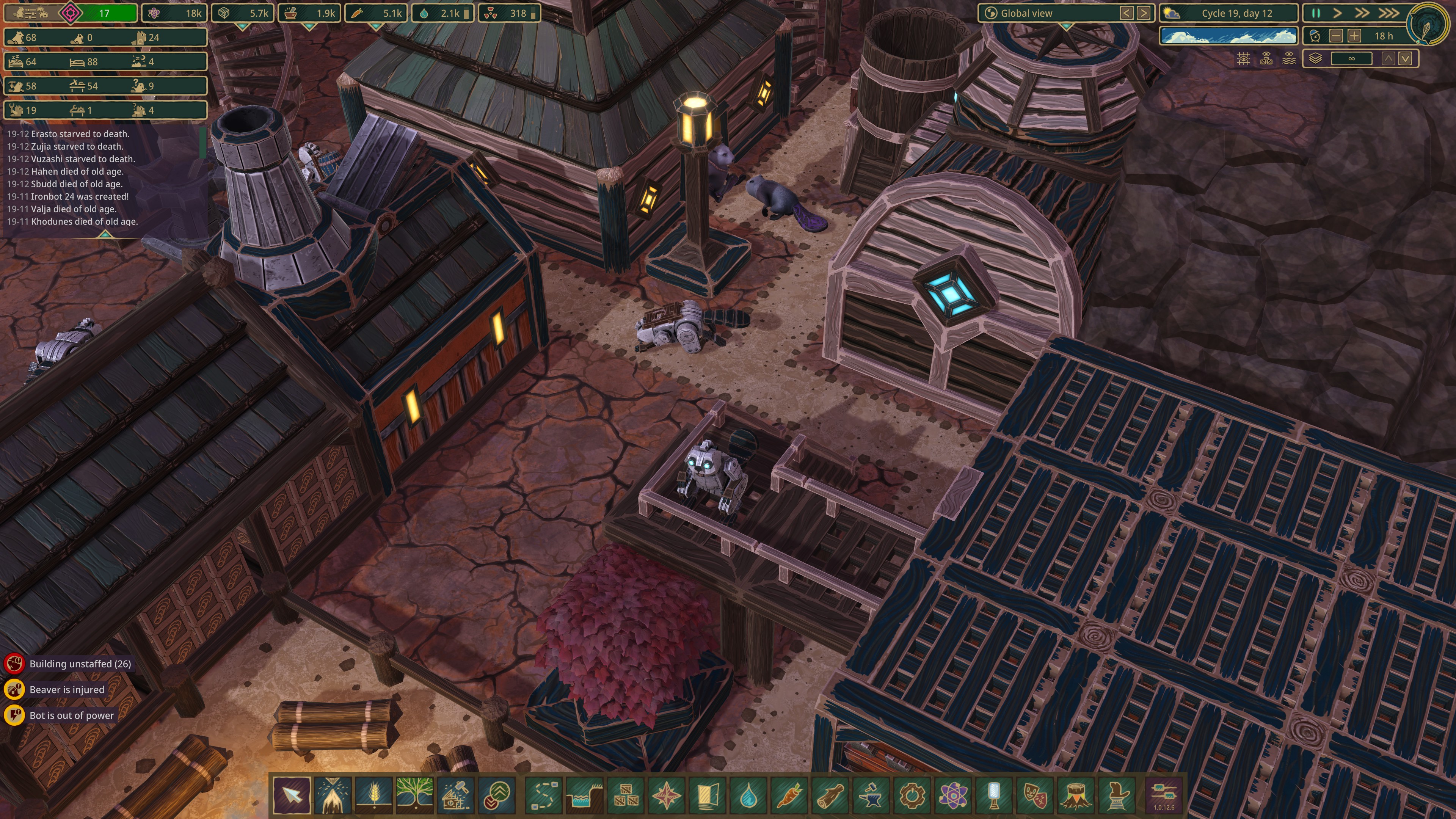 Look at this little guy - the beavers get to rest while the robo-beavers are doing the work. What happens to the 76 needs we should be fulfilling though?
There are self-driven megaprojects too - massive dams, terraforming efforts. The systems here are solid enough, but they’re plagued by the same problems as the mid-game. Every big project means more beavers, and more beavers means more showers, more theaters, more of the same infrastructure you’ve already built three times. All the systems scale linearly, in lock step.
Anno 1800 has a similar late game on paper - increasingly demanding populations, sprawling production chains across multiple islands. But that’s the point of Anno. Citizen tiers are how progress is gated. Every new tier of residents unlocks new resources, new buildings, new trade routes, and demands direct access to goods you don’t have yet. Timberborn’s late game asks you to care about three different games at once, and none of them reinforce each other.
I’ve been picking on Timberborn for a while now, but I should repeat - I did enjoy my time with it. The water management is a genuinely fun puzzle, and diverting rivers just doesn’t get old. Any new city builder is a win in my book, and the developer passion shows through. Go support the developer and buy the game (non-affiliate link).
Oh, and I wish there were more dwarves in this than beavers. I like dwarves.
Comments
Respond directly on Bluesky (threads shown below) or Medium (view comments there).